Motorized Electric Fin vs. Traditional Fin: Which One Is Worth It?
Motorized electric fin vs. traditional fin? It’s the debate lighting up surf communities, water sports forums, and gear review sites around the world right now. And it’s a genuinely important conversation because the answer isn’t as simple as “new is better” or “old is best.”
Both types of fins serve very different purposes, and choosing the wrong one for your surfing style could mean wasted money, frustrating sessions, or missing out on an experience that could completely transform how you enjoy the water.
Here’s what makes this comparison so fascinating: traditional fins have been the backbone of surfing for over 70 years. They’re battle-tested, beautifully engineered, and trusted by everyone from weekend beginners to World Surf League champions.
Motorized electric fins, on the other hand, are a genuinely new technology powered by the same advances in battery density and brushless motor efficiency that gave us electric cars and high-performance drones. They don’t replace the ocean. They just give you more of it.
What Is a Traditional Fin?
A traditional surfboard fin is one of the most elegant pieces of sports engineering ever created. It’s a fixed blade typically made from fiberglass, carbon fiber, or a honeycomb composite that inserts into a fin box on the underside of your surfboard and stays there passively as you ride.
It has one job: hydrodynamic control. As water flows across the fin’s surface, it creates lateral resistance that prevents the board from skidding sideways.
The fin’s shape, size, cant angle, and flex pattern all influence how the board responds, how tightly it turns, how stable it tracks, and how snappy it feels underfoot on a wave. A larger fin provides more drive and stability.
A smaller fin allows looser, more pivoting movement. A stiffer fin gives a direct, powerful response. A flexy fin absorbs energy and releases it smoothly.
Traditional fins come in three main setups: thruster (three fins), twin fin (two fins), single fin (one center fin), and quad (four fins).
Each setup creates a completely different riding character. The thruster popularized by shaper Simon Anderson in 1981 remains the most common setup in the world and is the baseline against which all fin technology is measured.
| Quick Fact: The modern removable fin box system was pioneered by Fin Control Systems (FCS) in 1992 and Futures Fins in 1996. Before that, fins were glassed directly onto boards meaning a snapped fin often meant a ruined board. |
What Is a Motorized Electric Fin?
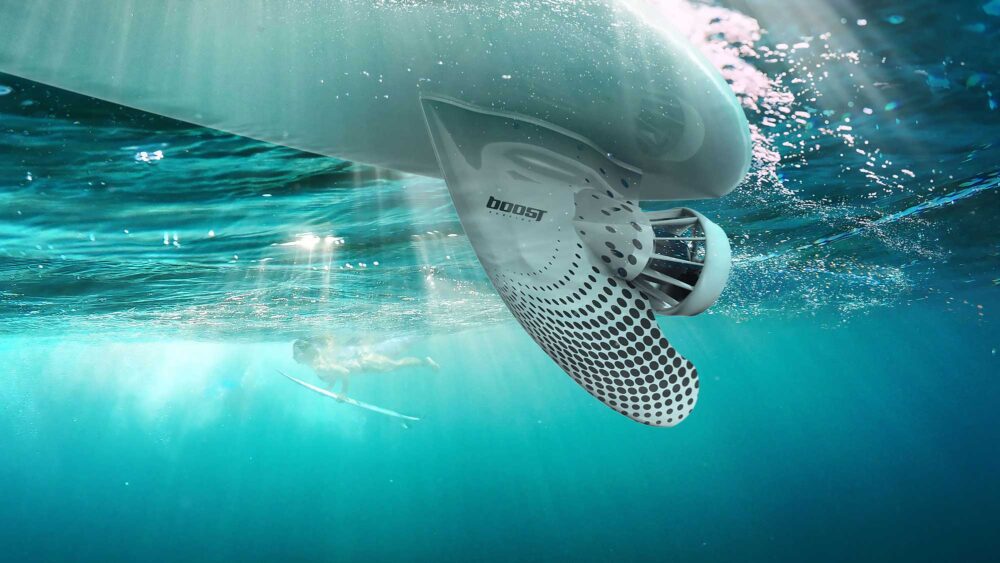
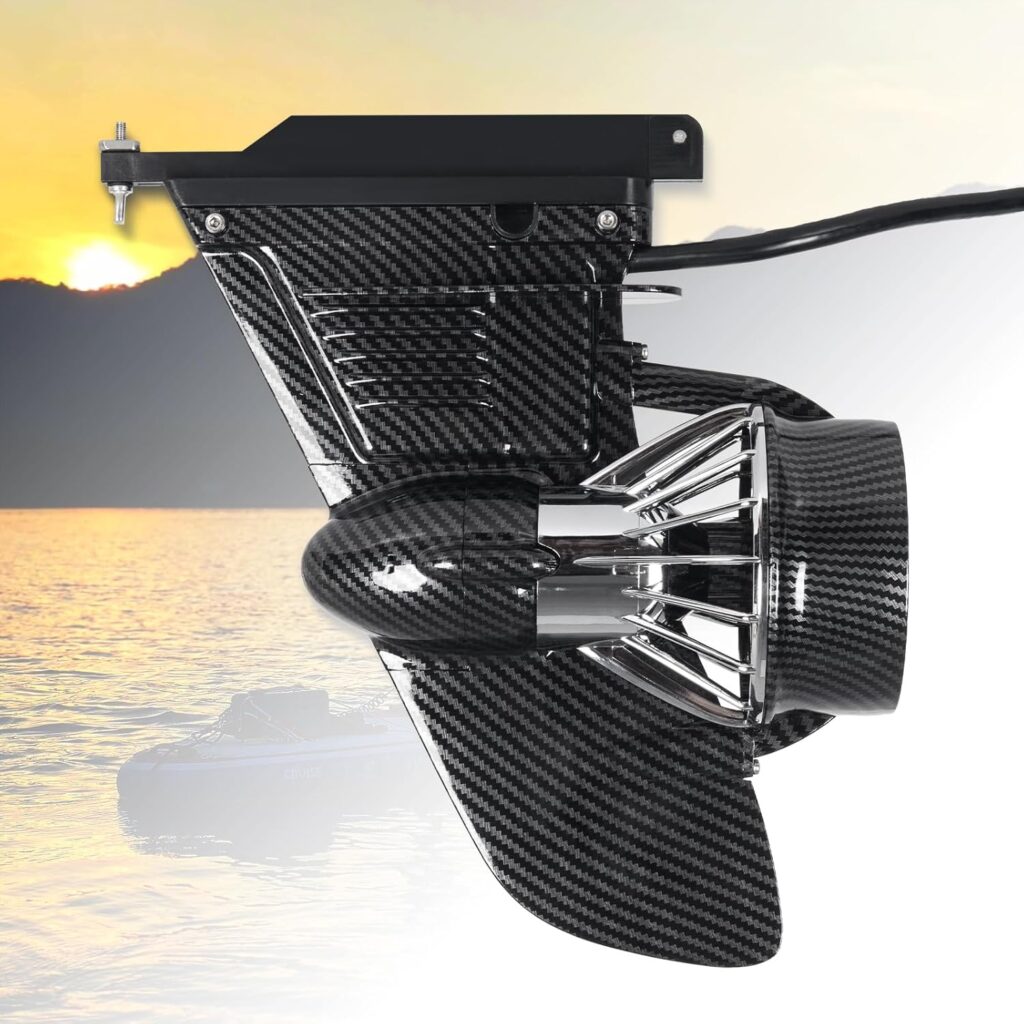
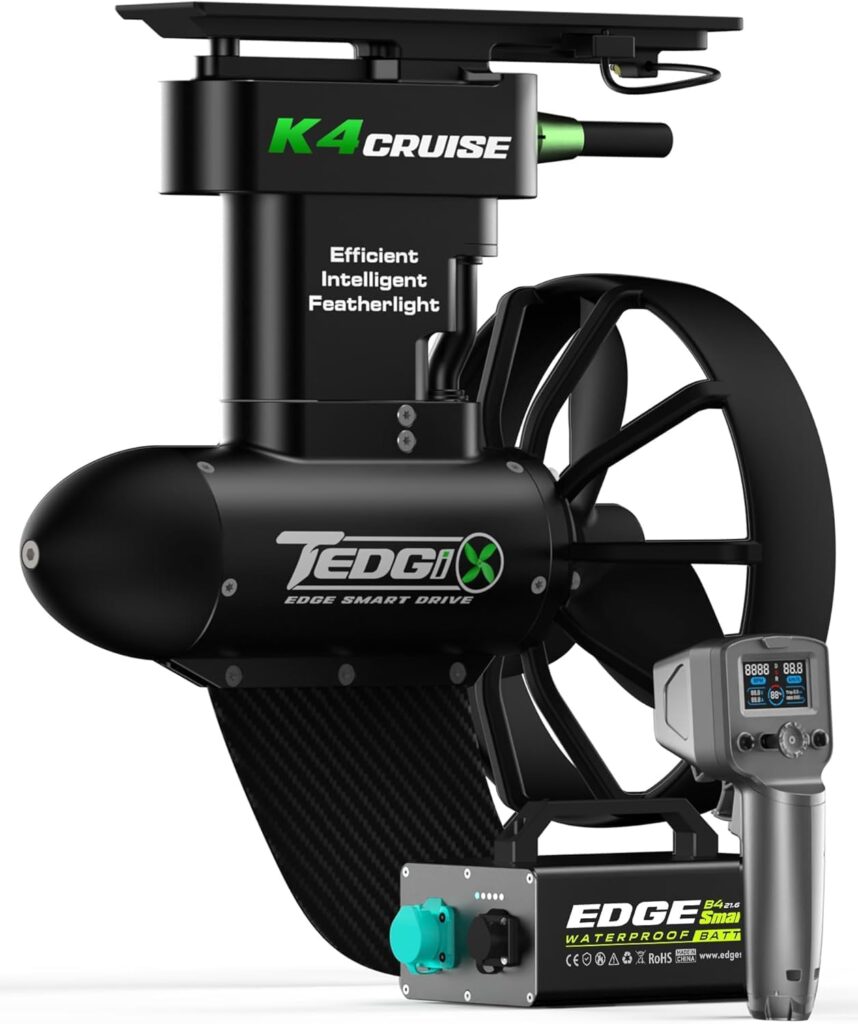
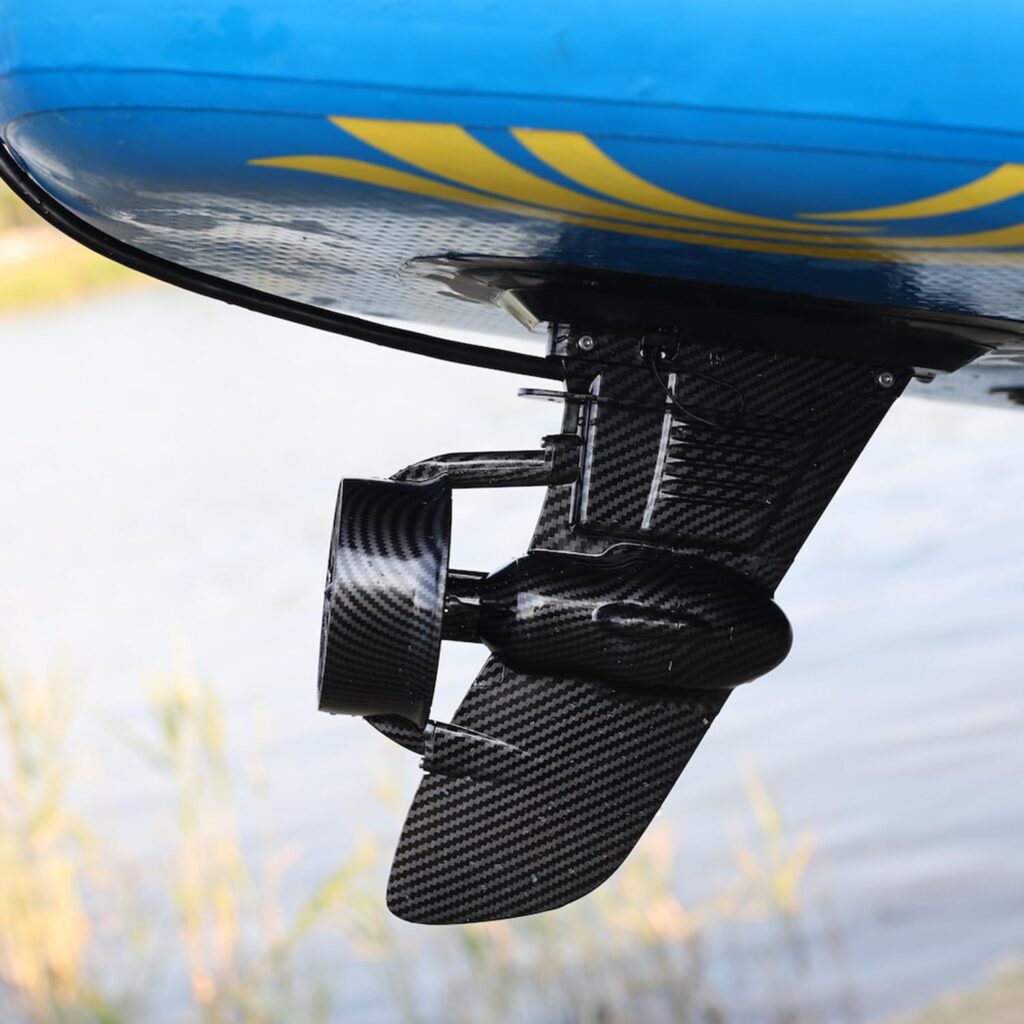
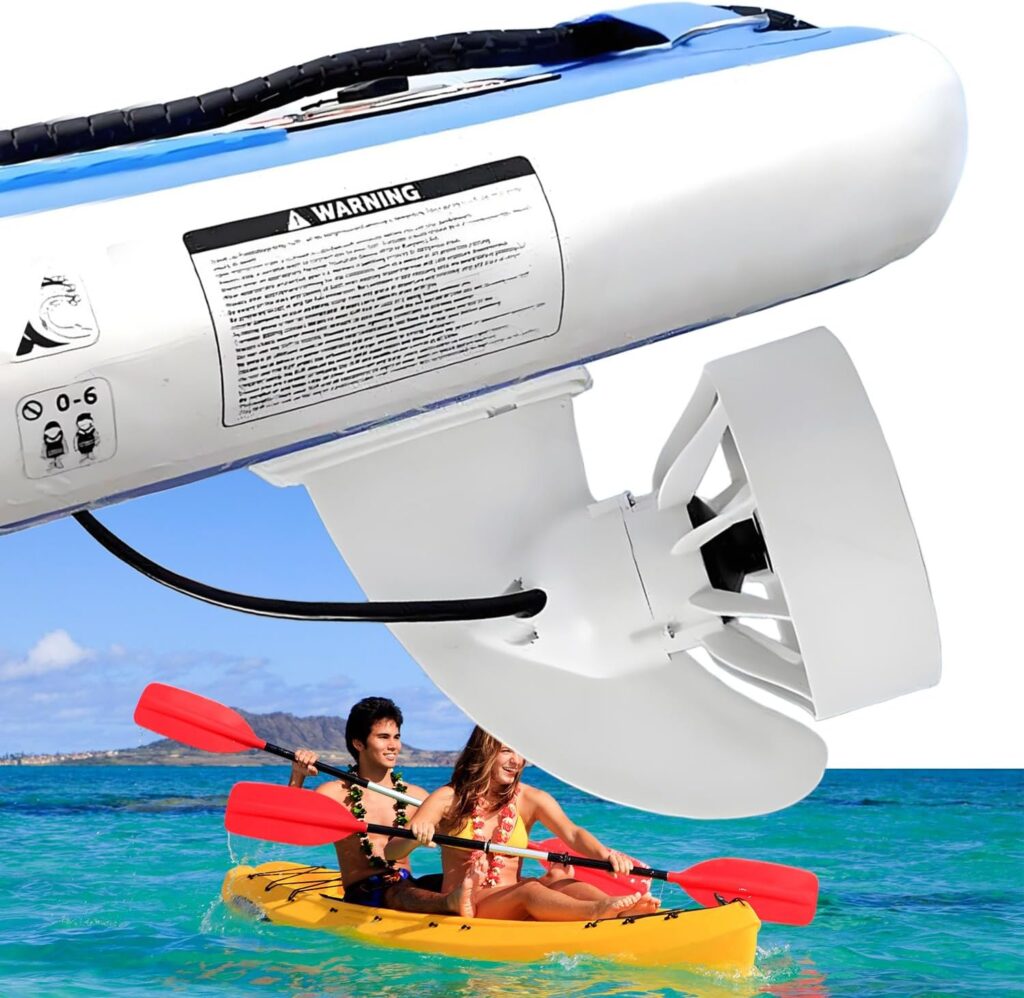
A motorized electric fin looks almost identical to a traditional fin from the outside. But inside that hydrodynamic shell lives a brushless electric motor, a rechargeable lithium-ion battery pack, a precision propeller, an Electronic Speed Controller (ESC), and a wireless communication system, all sealed in waterproof housing rated to IP67 or IP68 standards.
If you want a deep dive into the technology itself, our companion article “How Does a Motorized Electric Fin Work?” at watercomfy.com covers every component in detail.
But the short version is this: you charge it, slot it into your board’s existing fin box, pair a wrist-worn remote, squeeze the trigger, and the propeller generates forward thrust that moves your board through the water with or without waves.
The motor is brushless, the same technology used in high-performance drones, electric bicycles, and electric vehicles, which means it’s highly efficient, nearly silent, and built to last years of regular use.
The battery provides between 45 and 120 minutes of runtime, depending on the power setting. And the safety system cuts motor power instantly if you fall off the board.
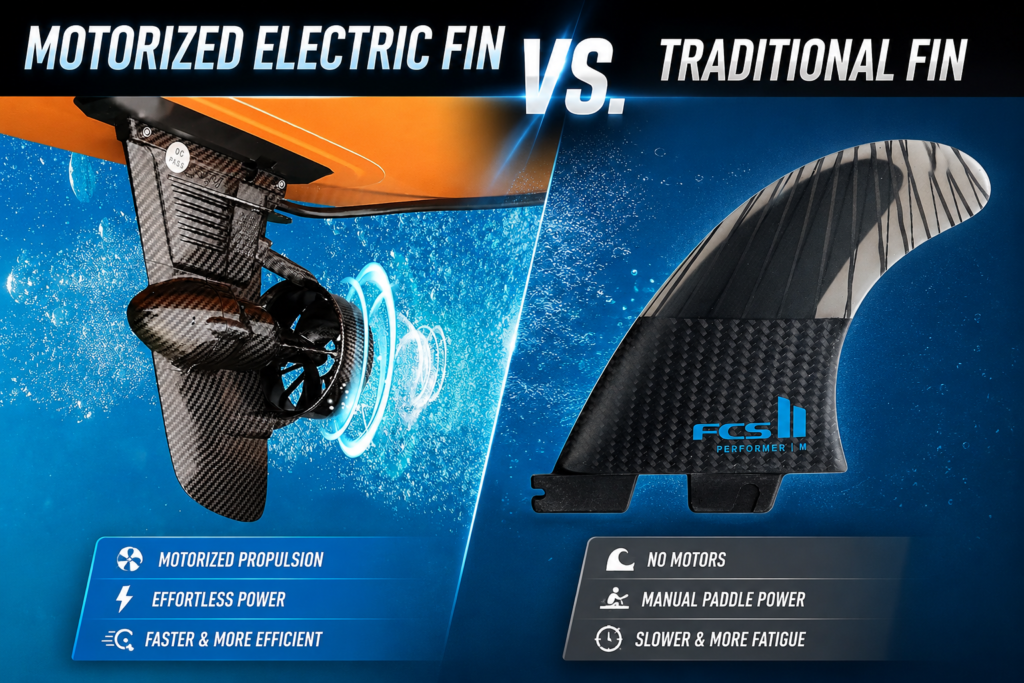
| Key Difference: A traditional fin is passive; it only responds to water and your movement. A motorized electric fin is active; it creates movement. That single difference defines everything else in this comparison. |
Motorized Electric Fin vs. Traditional Fin: The Complete Head-to-Head
Let’s look at every meaningful performance and practical category side by side.
| Category | Motorized Electric Fin | Traditional Fin |
| Propulsion | Electric motor + propeller | None — wave & paddle only |
| Battery Life | 45–120 min per charge | Unlimited (no battery) |
| Top Assisted Speed | 10–20+ km/h | Wave-dependent only |
| Weight | 0.8–2.1 kg | 0.1–0.4 kg |
| Price Range | $500–$2,500+ | $20–$300 |
| Fin Box Compatibility | FCS II, Futures (most models) | FCS, FCS II, Futures, Single |
| Maintenance | Rinse, charge, seal checks | Rinse and store |
| Noise Level | Near-silent (brushless motor) | None |
| Competition Legal | No (WSL / ISA rules) | Yes |
| Best Water Conditions | Flat water, ocean, lakes, rivers | Best in quality surf breaks |
| Best For | Beginners, touring, injured surfers | Performance & competition surfers |
| Learning Curve | Low — intuitive controls | High — technique dependent |
| Lifespan | 3–7 years (battery replacement req.) | 10–20+ years |
| Eco Footprint | Zero emissions while riding | Zero emissions |
Performance Comparison: What Each Fin Actually Feels Like
Wave Performance
In pure wave surfing, real ocean swells with power and shape, the motorized electric fin vs. traditional fin comparison starts to favor the traditional option. An experienced surfer on a good wave with a quality carbon fiber fin experiences total feedback from the water.
Every micro-adjustment of body weight translates directly through the fin. There’s no motor weight, no battery bulk, no added drag. The board feels alive.
A motorized electric fin adds weight (0.8–2.1 kg vs. 0.1–0.4 kg for a traditional fin) and a small amount of drag even when the motor is off, although modern ducted propeller designs have reduced this significantly.
On high-performance waves, advanced surfers will notice the difference. On casual waves and beginner sessions, most riders won’t.
Flat Water and Low-Swell Performance
This is where the story completely reverses. On flat water: lakes, calm bays, rivers, glassy coastal mornings with no swell, a traditional fin is almost useless for propulsion. You’re entirely dependent on your paddling.
A motorized electric fin transforms flat water into a playground. You can cruise at 10–15 km/h, cover kilometers of coastline, reach breaks that paddling alone makes impractical, and still have energy left when you arrive.
For stand-up paddleboarders, this is perhaps the most dramatic application. The difference between paddling a 3 km ocean route and motoring it effortlessly at 12 km/h is the difference between an exhausting workout and a genuinely enjoyable experience.
Paddling and Endurance
One of the clearest wins in the motorized electric fin vs. traditional fin comparison is paddling endurance. Traditional surfing demands significant upper body fitness, paddling out through whitewash, repositioning on the lineup, and chasing sets.
For beginners, older surfers, or anyone recovering from a shoulder or back injury, this can be genuinely limiting.
A motorized electric fin dramatically reduces paddling demand. You can get out through a lineup with a fraction of the effort, reposition quickly, and catch far more waves in a session.
Studies on water sports fatigue consistently show that perceived exertion drops significantly when assisted propulsion is available, meaning you surf longer, enjoy it more, and feel better afterward.
How Does a Motorized Electric Fin Work Compared to a Traditional Fin?
Understanding how a motorized electric fin works relative to a traditional fin helps clarify why these two devices feel so different in the water.
A traditional fin works entirely through passive fluid dynamics. As water flows around the fin’s curved surface (shaped similarly to an aircraft wing), pressure differences on either side create lift forces that resist sideways movement and generate drive.
The more water flowing across the fin, the faster you’re going, the more lateral stability and drive the fin provides. No electricity, no moving parts, no maintenance beyond rinsing.
A motorized electric fin uses all of that same hydrodynamic principle for stability and steering, plus adds active propulsion via an electric motor and propeller. The key insight is that both types of fins share the same passive hydrodynamic foundation.
The motorized fin adds capability; it doesn’t replace the fundamental physics. This is why turning off the motor on a motorized fin makes it behave almost identically to a traditional fin of similar dimensions.
| Worth Knowing: The brushless motors in today’s best motorized electric fins for surfing generate between 400W and 1,200W of power comparable to a small electric bicycle motor, but engineered specifically for underwater operation and waterproof to depths of 30–50 meters. |
Cost Comparison: What You’re Really Paying For
The cost difference in the motorized electric fin vs. traditional fin debate is significant and worth examining honestly.
| Cost Item | Motorized Electric Fin | Traditional Fin |
| Initial Purchase | $500 – $2,500+ | $20 – $300 |
| Replacement Battery | $80 – $200 (every 2–4 yrs) | N/A |
| Controller/Remote | Usually included | N/A |
| Maintenance Supplies | Seal kits ~$15–$30/yr | Fin wax/polish ~$5/yr |
| Repair Costs | Motor/ESC $100–$300 | Ding repair $10–$50 |
| 5-Year Total (est.) | $700 – $3,000+ | $25 – $350 |
Traditional fins offer extraordinary value. A quality carbon fiber traditional fin from a reputable brand like FCS, Futures, or Creatures of Leisure costs $80–$200, lasts a decade or more with basic care, and never needs charging or servicing beyond rinsing. Budget fiberglass options start under $30.
Motorized electric fins require a larger initial investment and ongoing battery replacement every few years. However, the cost-per-session picture is more nuanced if a motorized fin doubles the number of enjoyable sessions you have per year (by enabling flat-water sessions and reducing paddling fatigue), the value calculation shifts considerably.
| Smart Buyer Tip: Look for motorized electric fins with user-replaceable battery packs. A fin that costs $1,200 but allows you to swap $100 battery every 3 years is a far better long-term investment than a sealed unit that becomes expensive e-waste when the battery dies. |
Are Motorized Electric Fins Legal? The Rules You Need to Know
One of the most searched questions in this space is: Are motorized electric fins legal? And it’s an important one because the answer varies depending on where you surf and what you’re doing.
In Competitive Surfing
The World Surf League (WSL) and International Surfing Association (ISA), the two most authoritative bodies in professional and amateur competitive surfing, prohibit motorized assistance in all sanctioned events.
This is a firm, universal rule. If you compete, a motorized electric fin is not an option for your competition board. Traditional fins are the only permitted option in structured surfing events worldwide.
In Recreational Surfing — United States
There is no single federal law in the U.S. specifically targeting motorized surfboard fins.
However, because the device provides motorized propulsion, individual states and municipalities may classify the board as a motorized watercraft, triggering registration, insurance, or zone restriction requirements.
California’s protected marine areas, for example, prohibit motorized watercraft of any kind in designated zones. Always verify with your local beach authority and state maritime department.
In Recreational Surfing — Australia
Australian maritime regulations vary by state. In New South Wales and Queensland, where recreational surfing is most concentrated, Transport for NSW and Maritime Safety Queensland have not yet issued specific guidance for motorized surfboard fins, but existing motorized watercraft regulations may apply.
The safest approach is to check directly with your state’s transport authority before your first session.
In Recreational Surfing — Europe
The United Kingdom’s Maritime and Coastguard Agency (MCA), France’s Direction des Affaires Maritimes, and Germany’s Federal Waterways and Shipping Administration all regulate motorized personal watercraft.
Motorized surfboard fins may fall under these frameworks depending on local interpretation. Regulations across Europe are actively evolving as electric personal watercraft grow in popularity.
The Responsible Rider Approach
The single most important thing to understand about motorized electric fin legality is that the regulations are still catching up to the technology. Most authorities respond positively to responsible, informed riders who proactively check local rules, respect no-motor zones, and set a good example in the water.
| Are Motorized Electric Fins Legal Where You Surf? Do This: Check your state or national maritime authority’s website for personal electric watercraft guidance. Contact your local beach authority or surf club directly; they’ll know zone-specific rules. Avoid all designated swimming areas, marine protected zones, and wildlife sanctuaries. Carry your fin’s purchase documentation and specification sheet when riding. Ride at considerate speeds near other water users; behavior shapes future regulation. |
The Best Motorized Electric Fins for Surfing Right Now
If the motorized electric fin vs. traditional fin comparison has you leaning toward the motorized option, here are the standout models worth considering in 2026. For a full breakdown with specs, check our comprehensive guide to the best motorized electric fins for surfing.
Traditional Fin Recommendations
If the comparison lands you firmly in the traditional camp, these are the benchmarks:
- FCS II Performer PC Carbon — One of the most versatile all-round thrusters; ideal stiffness-to-weight ratio for most surfers and conditions.
- Futures Al Merrick AM2 — A legendary template from shaper Al Merrick; excellent pivot and drive balance for intermediate to advanced surfers.
- Creatures of Leisure Icon — A brilliant entry-level to intermediate fin; strong build quality at a genuinely accessible price point.
- FCS II Accelerator Neo Glass — Outstanding all-round performance for surfers progressing beyond beginner level; great value.
Which Fin Is Right for You? The Decision Guide
The motorized electric fin vs. traditional fin question ultimately comes down to who you are as a surfer and what you want from your time on the water. Here’s a clear framework.
| Surfer Type | Best Fin Choice | Reason |
| Beginner | Motorized Electric Fin | Less paddle fatigue, easier learning curve |
| Intermediate | Either — try both | Motorized for exploration, traditional for skill-building |
| Advanced / Competitive | Traditional Fin | Competition legal, pure performance feel |
| Older / Injured Surfer | Motorized Electric Fin | Reduces physical demand significantly |
| Ocean Explorer / Tourer | Motorized Electric Fin | Range and endurance unmatched |
| Budget Buyer | Traditional Fin | Far lower cost of entry and ownership |
| SUP Enthusiast | Motorized Electric Fin | Game-changing for flat-water touring |
| Competitive Athlete | Traditional Fin | Motorized fins are banned in events |
The most important insight here is that motorized and traditional fins are not in competition; they serve different purposes. Many surfers who own motorized fins also own a set of traditional fins for their dedicated wave-surfing sessions.
Treating them as complementary tools rather than competing alternatives is the most accurate way to think about the choice.
Frequently Asked Questions
Can I use a motorized electric fin in a traditional fin box?
Yes, most motorized electric fins are engineered specifically for FCS II or Futures fin boxes, the same systems used by traditional fins. Always verify compatibility with your specific board before purchasing. Adapters are available for older or non-standard box systems.
Will a motorized electric fin damage my surfboard?
No, when properly installed in the correct fin box, a motorized electric fin exerts no more stress on the board than a traditional fin. The additional weight is distributed across the fin box in the same way. Always use the locking key or screw provided and never force a fin that doesn’t fit cleanly.
Does a motorized electric fin replace all three fins on a thruster setup?
No, typically only the center fin position is replaced by the motorized electric fin. The two side fins remain as standard traditional fins. This preserves the board’s turning performance and hydrodynamic balance while adding center-fin propulsion.
Is a motorized electric fin noticeably heavier than a traditional fin?
Yes, a motorized fin weighs 0.8 to 2.1 kg compared to 0.1 to 0.4 kg for a traditional fin. You’ll notice the weight when carrying the board, but most riders report that once in the water, the difference is minimal because the board’s buoyancy and your body weight dominate the overall mass equation.
How long do the best motorized electric fins for surfing last?
With proper care, quality motorized fins last 3–7 years. The motor and housing typically outlast the battery, which degrades after approximately 500–1,000 charge cycles (roughly 2–4 years of regular use). Fins with user-replaceable battery packs can realistically last a decade or more.
Can a traditional fin generate any propulsion?
Not actively. A traditional fin generates drive, which helps maintain speed gained from a wave, but it produces no independent propulsion. If there’s no wave energy and no paddling, a traditional fin does nothing to move the board forward.
Which is more environmentally friendly — motorized or traditional?
Both produce zero direct emissions while in use. Traditional fins have a lower manufacturing footprint; they’re simpler materials with no electronics. Motorized fins involve lithium-ion battery production, which has a higher environmental manufacturing cost.
However, responsible battery disposal and recycling programs mitigate this significantly. In use, both are clean.
Can I switch between motorized and traditional fins on the same board?
Absolutely, and this is one of the most practical approaches for surfers who want the best of both options.
Keep a set of traditional fins for your performance wave sessions and competitions, and swap in the motorized fin for flat-water days, touring sessions, or when your body needs a lower-intensity session.
Do motorized electric fins work in surf competitions?
No. All major competitive surfing organizations, including the WSL and ISA, prohibit motorized assistance in sanctioned events. Traditional fins are the only permitted option in structured competitive surfing at every level.
How does the motorized electric fin vs. traditional fin comparison change for SUP?
For stand-up paddleboarding, the comparison shifts even more decisively toward the motorized option. On a SUP board, the primary mode of movement is paddling, which a motorized fin can dramatically supplement or even replace for low-intensity touring.
Traditional fins on SUP boards provide directional stability but contribute nothing to propulsion. For touring, exploration, and casual lake or coastal sessions, a motorized fin on a SUP board is a transformative upgrade.
Are there any safety concerns specific to motorized fins that traditional fins don’t have?
The main safety consideration unique to motorized fins is the propeller. A spinning propeller poses a contact risk to swimmers and marine life, which is why all reputable motorized fins use ducted or guarded propeller designs.
Always confirm your fin has an enclosed propeller and a safety cut-off before using it in populated water. Traditional fins present no propeller risk but can cause cuts and bruising from impact, a risk present in both fin types.
What happens to a motorized electric fin in very cold water?
Cold water affects lithium-ion battery performance, reducing capacity by approximately 15–25% in water temperatures below 10°C (50°F). This is the same phenomenon observed in all lithium battery devices.
Plan for shorter sessions in cold conditions or keep a spare battery pack. The motor and housing are unaffected by cold water temperatures within normal ocean ranges.
The Bottom Line on Motorized Electric Fin Vs. Traditional Fin
The motorized electric fin vs. traditional fin debate doesn’t have a universal winner because they’re genuinely designed for different things. A traditional fin is the gold standard for performance wave surfing, competition use, and anyone who values simplicity, pure feel, and decades of proven engineering.
A motorized electric fin is the right answer for anyone who wants more access to the water: more range, more sessions, less fatigue, and the freedom to surf conditions that traditional fins simply can’t power through.
And yes, motorized electric fins are legal for recreational use in most parts of the world, with the important caveat of always checking local maritime regulations before your first session. The rules are still evolving, and responsible riders who do their homework are the best advocates the sport has.
Whichever fin you choose, the ocean is still out there. Go find it.